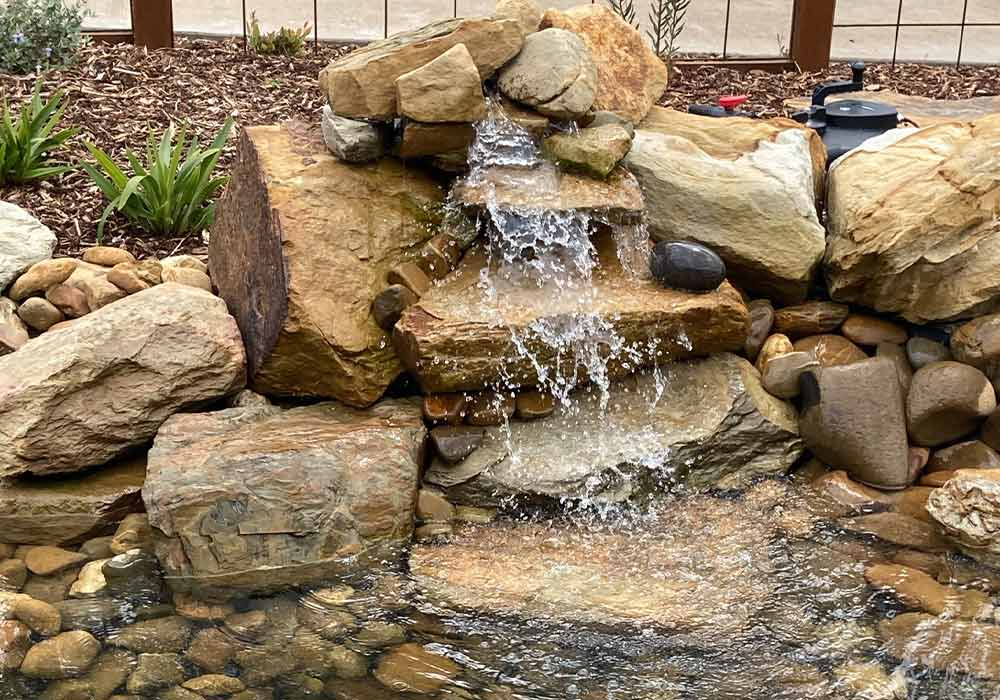
When planning landscaping water features on the Mornington Peninsula, deciding where the feature should sit is just as important as choosing how it will look. At Luke Bullock Landscape Construction, we position water features in response to the home, garden layout, surrounding planting, outdoor living areas and the way people move through the property. A well-positioned water feature can introduce movement and sound while creating a focal point that feels connected to the wider landscape.
There is no single position that works for every property. A water feature designed to be viewed through a living-room window has a different purpose from a waterfall beside an outdoor entertaining area or a naturalistic cascade incorporated into a larger garden. Before determining its position, we first need to understand what the water feature is intended to contribute to the landscape.
Start with where the water feature will be experienced
One of the first questions we consider is where people will actually see and hear the water feature.
A feature does not need to be physically close to the house to have an impact. In some landscapes, positioning it deeper within the garden can create a strong sightline from inside the home or draw people through the landscape. In others, placing it closer to a terrace, courtyard or entertaining area allows the sound and movement of water to become part of the outdoor living environment.
This is why we consider views from both inside and outside the home. Kitchen windows, living areas, entrances, decks and frequently used pathways can all influence positioning. If a water feature is only visible from a part of the garden that is rarely used, an opportunity to make it a meaningful part of the property may be lost.
The same applies to sound. Falling water beside an entertaining area can help establish atmosphere, while a quieter feature may be more appropriate near a secluded seating area. The volume and character of the sound are influenced by factors including the height of the water movement, the surface it falls onto and the surrounding built and planted environment.
Water feature placement should respond to the whole landscape
A common mistake is to decide that a garden needs a water feature and then look for an empty space to put it. We approach the process differently.
At Luke Bullock Landscape Construction, water features are often designed as part of a broader landscaping project. This allows us to consider the feature alongside paving, planting, retaining walls, rockwork, lawn, pathways and outdoor entertaining areas rather than treating it as an isolated object.
The surrounding landscape can be just as important as the water itself. Planting can soften constructed edges and frame views, while stone and rockwork can help a waterfall landscaping project feel integrated into the site. Changes in level may create opportunities for cascading water, particularly where retaining structures or existing slopes already form part of the landscape.
Luke Bullock has extensive experience with naturalistic water features, including cascading systems designed around existing terrain and rock. The objective is not necessarily to make every feature look untouched by human hands, but its position, scale and materials should make sense within the landscape.
Scale influences where a water feature belongs
The scale of a water feature needs to suit both the space around it and the role it plays within the overall landscape. We consider how large the feature will appear from important viewing points, how much visual attention it should command and whether the surrounding garden has enough space and structure to support it.
A substantial waterfall may be appropriate within a large garden where there is enough surrounding space, planting and topography to support it. Place the same feature in a compact courtyard and it may dominate everything around it. Conversely, a small feature can disappear visually if it is positioned within a broad landscape without enough structure to frame it.
We therefore look at the relationship between the water feature and nearby elements. The height of retaining walls, width of garden beds, size of outdoor entertaining areas, surrounding vegetation and architecture of the home can all affect what feels appropriately scaled.
This becomes particularly important on larger Mornington Peninsula properties. A water feature may need to be viewed from a considerable distance, so its scale and position should be considered together rather than independently.
Waterfall landscaping can take advantage of changes in level
Water naturally moves downhill, and a landscape with existing changes in elevation can create excellent opportunities for waterfall landscaping.
Rather than forcing a cascade into a flat area, we can sometimes use the property’s contours, retaining walls or changes between garden levels to create a more convincing transition. Rock and stone can then be incorporated with planting to connect the feature to the rest of the garden.
This does not mean a waterfall can only be installed on a sloping property. Professional water feature installation can create changes in level where required. However, understanding the existing terrain early can lead to a more integrated result and influence how much structural and excavation work is needed.
For Mornington Peninsula landscapes that already use natural stone or rock retaining walls, repeating compatible materials around a water feature can also help establish visual continuity across the property.
Think about access before construction begins
A water feature should look integrated into the garden, but it should not be positioned so tightly within the landscape that essential components become difficult to access.
Pumps, filtration equipment and other parts of the system need to be considered during water feature installation. The feature itself may also require periodic cleaning and maintenance. We account for that access during design so practical requirements do not have to be solved after construction.
Electrical supply, water supply where required, excavation, structural requirements and the route taken by pipes and equipment can also influence the final position. These are some of the reasons we prefer to consider water features during the broader landscape design process. Planning them early gives us more freedom to integrate the necessary infrastructure discreetly.
Consider safety as part of the design
Any body of water in a residential landscape deserves careful consideration, particularly where young children use or visit the property.
Victoria’s Building and Plumbing Commission states that ornamental ponds and water features have different requirements from swimming pools and spas, and notes that any structure containing water can still present a drowning risk. The Victorian Government’s Better Health Channel also recommends precautions around ponds and other exposed water sources where young children are present.
For us, the important point is that safety needs to be considered according to the type, depth, design and intended use of the feature rather than assumed from its appearance. If there is uncertainty about regulatory requirements for a particular design, these should be established before construction begins.
Planting can make a water feature feel established
Planting is one of the most effective ways to integrate a water feature into a garden.
The appropriate planting approach depends on the design. A contemporary architectural feature may benefit from restrained planting that keeps its form visible. A naturalistic waterfall may need layered vegetation around rocks and edges to create the impression that the water belongs within the garden.
We also consider mature plant size rather than designing only for how the garden looks immediately after installation. Plants that eventually obscure the main view, continually drop material into the water or make maintenance access difficult can undermine an otherwise successful design.
Our garden installation work can therefore be planned alongside the water feature itself, allowing the planting, stonework and water to develop as one composition rather than separate additions.
Lighting changes how a water feature works after dark
If a water feature can be seen from an entertaining area or through the windows of the home, landscape lighting can extend its impact well beyond daylight hours.
Luke Bullock Landscape Construction uses landscape lighting to highlight features, planting and architectural elements throughout outdoor spaces. With water, carefully positioned lighting can emphasise movement, reflections, stone textures and surrounding vegetation.
The important point is that lighting should support the water feature rather than overwhelm it. Considering lighting during the original design also allows cabling and fittings to be incorporated more discreetly than if illumination is added after the landscape is complete.
The best position is the one that connects the water feature to the landscape
There is no formula that says a water feature belongs in the centre of the garden, beside a deck or against a boundary. The right position is determined by what the feature is intended to achieve and how it relates to the rest of the property.
This is why we prefer to consider water feature installation as part of the overall landscape rather than an isolated addition. Position, scale, materials, planting, access, lighting and construction all contribute to whether the finished feature feels genuinely connected to the property.
Luke Bullock Landscape Construction designs and constructs custom landscaping water features across the Mornington Peninsula, including features incorporated into complete residential landscape projects. If you are considering adding water to your garden, contact Luke Bullock Landscape Construction to discuss how the feature can be positioned and designed as part of your wider landscape.